
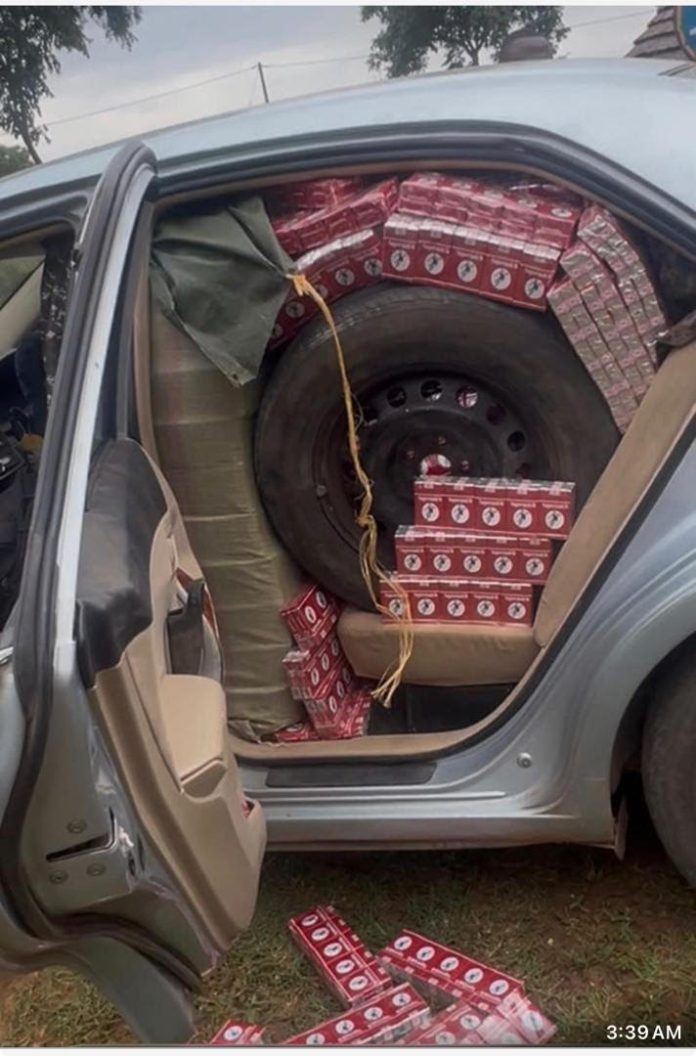



The Uganda People’s Defence Forces (UPDF) saloon vehicle, a Toyota Premio registered under the standard military code H4DF 3449 was over the weekend intercepted carrying contraband (cigarettes) during the massive anti-smuggling crackdown in West Nile. Sources within the URA enforcement team intimate that the vehicle which was filled up with smuggled cigarettes from the Democratic Republic of Congo (DRC) was intercepted by the Uganda Revenue Authority enforcement team and impounded to their offices in West Nile. The vehicle in question is affiliated to Uganda Revenue Authority (URA) and the shocker is that some elements within URA could be fuelling the unlawful trade.

The impounded vehicle
The preliminary investigations indicate that the consignment could be part of the big smuggling cartel that was recently intercepted by Kenya Ports Authority but later released to continue in transit through Port Sudan. It is not clear yet why the URA’s Assistant Commissioner Public and Corporate Affairs Robert Kalumba who is fond of parading the smugglers has kept mum about the incident.
It should be noted that a couple of months ago, a multi-agency team led by the Kenya Revenue Authority (KRA) intercepted a 40-feet container at the Port of Mombasa carrying 9.5 million illicit cigarettes disguised as sanitary towels, estimated at Shs76m in evaded taxes. According to the shipping manifest, the container, which arrived from Thailand aboard a CMA CGM vessel, was declared to contain 1,100 boxes of sanitary towels. The consigner was listed as Igma Trade, while the consignee was Lotec Foundation, based in Nairobi. Cigarette smuggling in Uganda is a severe and sophisticated illicit trade network that costs the country up to Shs200bn annually in lost tax revenue.

Hajji Asadu
Driven by high excise taxes on tobacco products intended to protect local manufacturers and discourage consumption, smuggling has become a norm. This thriving illicit market impacts state revenue, disrupts the legitimate tobacco industry, and poses severe public health threats.
Cigarettes are manufactured legally within Uganda or imported from global hubs (like the Middle East) explicitly marked for the export market. Because they are intended for export to regional neighbors like the Central African Republic (CAR) or South Sudan, they are exempt from local Ugandan excise taxes.
However before reaching their final destination, transit trucks officially – cross the Ugandan borders, reach neighboring territories (like South Sudan, DRC), and immediately turn back en-route to Kenya. This is orchestrated by a group of powerful Somali businessmen of Kenyan origin for strategic business interventions.
Besides, the porous borders of East Africa provide ample opportunity for illicit networks to move products flawlessly, there are known places on the West Nile & Northern corridor and Eastern borders that primarily serve as entry points.
Smugglers reportedly utilize informal border crossings (panya roads) to bypass main custom checkpoints. Though several measures have been put to combat the financial hemorrhage and control the illicit trade by joint military and intelligence raids, the illegal trade is on the rise.
BIGGER CRISIS IN CUSTOMS DEPARTMENT
Meanwhile, the crisis at URA’s customs department increases every day that passes due to the fact that the Commissioner General deliberately waged wars of ego against fellow commissioners by creating a Cabal that has since failed to yield any tangible results.
It is about six months now since the Commissioner for Customs Hajji Asadu Kigozi Kisitu (whose whereabouts are hitherto unknown) was suspended. The country’s tax body has labored much to build a case against him in vain. The wars of ego and confusion between the Commissioner General and fellow commissioners have put the activities at a standstill and lately they forced out the Board Chairman Emmanuel Katongole.
The Commissioner General is bent on crushing Asadu’s rich experience by preferring changes and having the latter charged and dismissed. It should be recalled that the UPDF team attached to URA has been raiding different places and homes of his relatives with hopes of apprehending Asadu but all in vain.
The situation worsened after the Board meeting held on September 22, 2026 when the then Board Chairman established that there was no case against the accused senior officers.
Katongole guided that since the Commissioner General was not comfortable to continue working with Asadu and other senior commissioners, the latter (senior commissioners) in appreciation of their excellent service to the country over the years should be given an offer to resign honorably to pave way for the replacement with people of his choice.
In protest, the Commissioner General stood up before the Board Chairman could finish his submission and said “that will be done over my dead body.”
It was at that point the Board members realized that the matters were personal and it was not long before the Board Chairman tendered his resignation.
Meanwhile, the new orchestrated plan to charge Asadu is re-scheduled for October 28, 2026. The scheme is to invite Asadu to appear for a disciplinary session again so as to execute the arrest from the boardroom. Insiders reveal that in absence of a substantive Board Chairperson, Hellen Awidi, a board member representing the private sector was selected to execute this mission. All this is unfolding at the time when the country is undergoing an immense economic wave with uncontrollable inflation. It should be noted that when URA was at its lowest and struggling to hit the target with growing pressure from the head of state, Asadu was identified as a savior and his ascendance to the office of Commissioner Customs the trend was reversed. With the current economic situation when the shilling is depreciating against major foreign currencies and the traders are struggling with excessive arbitrary tax assessments, the CG and his cohorts are in cat and mouse wars. It’s important that the Minister of Finance triggers an action that will save the country since staff insecurities at the Tax Body are fuelling the economic crisis. With the current Dollar rate at Shs4,500, an indication of 26% depreciation, experts predict that it will soon impact the high costs for imported goods. They further warn that if the Commissioner General fails to envisage the fact that personal wars are crushing the economy, the situation will keep deteriorating.
Watch this space!