
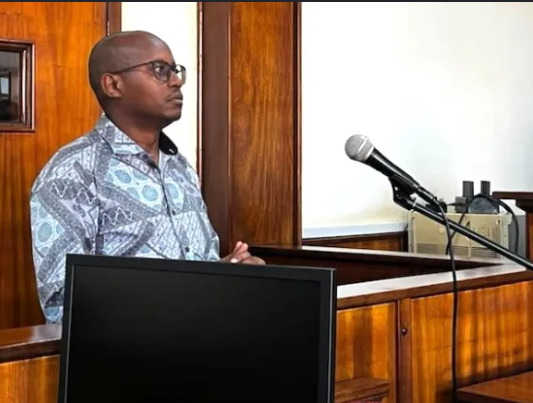



The Buganda Road Chief Magistrates Court has committed former Uganda Peoples’ Defence Forces (UPDF) soldier Michael Katungi Mpeirwe to Luzira Prison pending a decision by the Minister of Justice and Constitutional Affairs on his extradition to the United States.
Katungi is wanted by US authorities over allegations linked to an international drug-trafficking and arms-smuggling network.
He faces three charges in the United States involving cocaine trafficking, firearms offences and providing material support to a designated foreign terrorist organisation.
In a ruling delivered Friday through the Judiciary’s Electronic Court Case Management Information System (ECCMIS), Chief Magistrate Ritah Kidasa Neumbe dismissed the preliminary objections raised by Katungi’s defence and found that the Ugandan government had met the legal and evidentiary requirements for his committal under the Extradition Act.
Katungi is wanted before the United States District Court for the Eastern District of Virginia, where prosecutors accuse him of participating in an international conspiracy involving narcotics and weapons.
The first charge relates to an alleged conspiracy to distribute and possess at least five kilogrammes of cocaine, with knowledge that the drugs would ultimately be illegally imported into the United States.
The second charge concerns an alleged conspiracy to possess firearms, including a machine gun and destructive devices, in connection with drug trafficking.
The third charge alleges that Katungi conspired to provide material support or resources to the Cartel de Jalisco Nueva Generación (CJNG), a Mexican organisation designated by the United States as a foreign terrorist organisation.
US prosecutors allege that Katungi and his alleged associates sought to supply military-grade weapons to the cartel as part of a wider criminal enterprise.
Court rejects defence objections
Katungi was first brought before the Buganda Road Chief Magistrates Court on June 29, 2026, following an arrest warrant issued under the Extradition Act at the request of the US government.
Through his lawyers, including Macdusman Kabega, Frank Kandiho and Medard Lubega Sseggona, he challenged the extradition proceedings on several grounds.
The defence questioned the procedure used to initiate the case, the authority of government officials handling the extradition request, the admissibility of evidence submitted by US authorities, the involvement of the Director of Public Prosecutions and Katungi’s claim to diplomatic immunity.
The defence also raised concerns over discrepancies in case numbers and records appearing on ECCMIS.
However, the court found that the procedural issues did not prejudice Katungi’s right to a fair hearing.
Chief Magistrate Kidasa held that Section 10 of the Extradition Act gives the magistrate discretion over how extradition proceedings are conducted, within the broader framework of criminal procedure.
The court noted that Katungi had received the evidence relied upon by the prosecution, had cross-examined the government witness and had been given an opportunity to make detailed submissions.
The discrepancies in the electronic case records were also dismissed as administrative issues rather than defects that could deprive the court of jurisdiction.
Court upholds government’s authority
The defence had argued that because the allegations involved narcotics, the extradition request should have been processed under provisions of the Narcotic Drugs and Psychotropic Substances (Control) Act through the Attorney General.
The magistrate rejected the argument, distinguishing extradition proceedings from mutual legal assistance between countries.
According to the ruling, the relevant provisions of the narcotics law concern international cooperation in criminal investigations, including obtaining evidence and documents, rather than surrendering an accused person to another country for prosecution.
The court also found no legal problem with the Solicitor General participating in the proceedings, noting that the Interpretation Act allows the Solicitor General, in prescribed circumstances, to exercise certain powers and perform duties of the Attorney General.
Diplomatic immunity claim rejected
Katungi also argued that his previous diplomatic position protected him from extradition proceedings.
His lawyers told court that he had served as a deputy head of mission, including in Nigeria, and was therefore entitled to diplomatic immunity.
The court disagreed.
The magistrate explained that diplomatic immunity under the Vienna Convention on Diplomatic Relations, as incorporated into Ugandan law through the Diplomatic Privileges Act, primarily protects diplomatic agents from the jurisdiction of the receiving state.
In Katungi’s case, the court found that Nigeria was the relevant receiving state during his diplomatic assignment. Uganda, as the sending state, and the United States, where he had not been accredited, did not fall within the circumstances necessary for the claimed immunity.
The court consequently found that diplomatic immunity did not prevent Uganda from exercising jurisdiction over Katungi or considering the US extradition request.
DPP has authority to conduct extradition proceedings
The magistrate also rejected the defence’s argument that the Director of Public Prosecutions (DPP) lacked authority to institute and conduct extradition proceedings.
The defence had argued that extradition proceedings are distinct from ordinary criminal cases and pointed out that no Ugandan police file had been opened against Katungi in relation to the alleged offences.
But the court held that Article 120 of the Constitution gives the DPP authority to institute and conduct criminal proceedings, while Section 10 of the Extradition Act requires extradition hearings to be conducted, as nearly as possible, in the same manner as criminal proceedings.
The court therefore concluded that the DPP has the authority to represent the Republic in the judicial phase of extradition proceedings.
The absence of a Ugandan police file, the magistrate ruled, did not invalidate the proceedings because Katungi was being considered for surrender to face prosecution over allegations contained in a foreign indictment.
US evidence accepted
The court further found that Katungi’s identity was not contested and that the US arrest warrant and extradition documents had been properly authenticated in accordance with the Extradition Act.
The prosecution relied on the US extradition request, indictment and arrest warrant, alongside evidence from Detective Assistant Superintendent of Police Kule Yona, attached to the Criminal Investigations Directorate.
Kule told court that he received and processed the extradition request in Uganda, participated in efforts to trace and arrest Katungi, verified his identity and presented him before court.
During cross-examination, however, Kule acknowledged that he had not taken part in the US investigation and had no first-hand knowledge of the alleged cocaine trafficking, firearms conspiracy or alleged support for the terrorist organisation.
He also confirmed that Ugandan police had not opened a file against Katungi over the alleged conduct.
The court nevertheless ruled that the authenticated US documents could independently be relied upon under the Extradition Act and that foreign officials who prepared the documents did not all have to personally appear before the Ugandan court.
Alleged multimillion-euro arms deal
US prosecutors allege that Katungi was part of a sophisticated international network that sought to obtain and supply military-grade weapons to CJNG.
The alleged weapons included rocket launchers, grenades, sniper rifles, anti-personnel mines, anti-aircraft weapons and surface-to-air missile systems.
The indictment further alleges that Katungi worked with Bulgarian national Peter Dimitrov Mirchev, Kenyan national Elisha Odhiambo Asumo and Tanzanian national Subiro Osmund Mwapinga in an effort to obtain fraudulent End-User Certificates.
The documents were allegedly intended to conceal the final destination of weapons being procured from Bulgaria.
US court records allege that the group planned to supply weapons valued at approximately €53.7 million, equivalent to about US$58 million at the time cited in the case.
A test shipment involving 50 AK-47 rifles and ammunition was allegedly arranged using the falsified documentation.
Court records also allege that Mirchev had previously been associated with convicted international arms trafficker Viktor Bout.
Katungi is separately accused of conspiring to distribute at least five kilogrammes of cocaine, with prosecutors alleging that the drugs were intended for eventual smuggling into the United States.
Constitutional Court petition
Katungi has remained on remand at Luzira Prison since his arrest on June 29.
He had also challenged the extradition process before the Constitutional Court.
However, Friday’s ruling by the Buganda Road Chief Magistrates Court clears the way for the extradition process to proceed to the next stage, subject to the decision of the Minister of Justice and Constitutional Affairs.
The pending constitutional petition could consequently have limited practical effect if the extradition process proceeds, although its final status remains a matter for the Constitutional Court.