
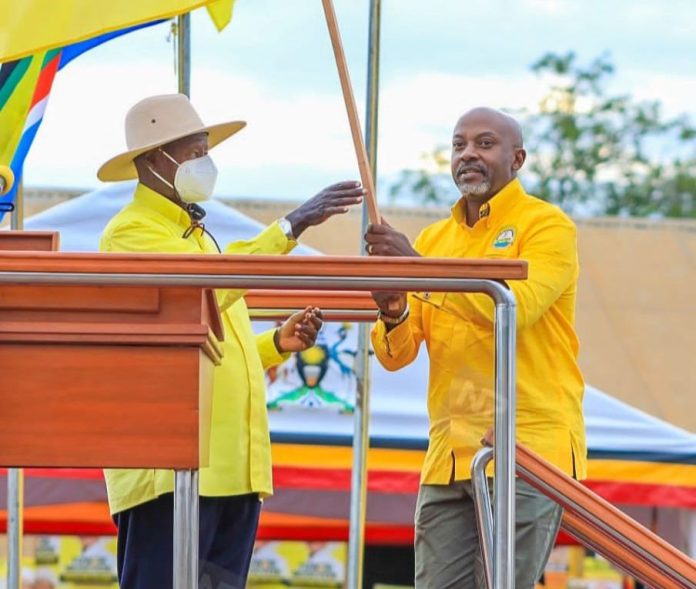


NRM lawmaker Dedan Mubangizi’s victory in the Buwekula South parliamentary race, eventually confirmed through a court-ordered vote recount, was not an overnight political miracle.
Rather, it was the culmination of nearly four years of sustained grassroots engagement that quietly reshaped voter attitudes in a constituency long resistant to party politics and dominated by independent candidates.
For decades, Buwekula South had remained outside the firm grip of the National Resistance Movement (NRM).
Every predecessor to Mubangizi emerged as an independent legislator, reflecting deep voter skepticism toward political parties.
Even Mubangizi’s main rival, Fred Tumwesigye, whose initial victory was later nullified by court over electoral irregularities, ran as an independent.
Against this backdrop, Mubangizi’s eventual emergence as one of the few NRM MPs from Buganda, a region now widely seen as an opposition stronghold under the National Unity Platform (NUP), marked a significant political shift.
That shift was driven less by party branding and more by visible, lived experience.
As early as 2022, long before the election cycle gained momentum, Mubangizi was already active on the ground.
One of the most cited examples among residents was his large-scale free medical outreach.
In July 2024, he sponsored a three-day medical camp in Kibyamirizi that treated over 10,000 people, offering eye care, dental services, general check-ups, and free medication.
Beyond temporary relief, he followed up by donating tangible medical equipment ultrasound machines, delivery beds, and patient beds to Kitenga Health Centre III, and earlier facilitated the provision of an ambulance and CT scan equipment to the Health Centre IV.
For many voters, this was their first direct encounter with a leader addressing health needs without campaign conditions attached.
Education formed the second pillar of his long-term engagement. Mubangizi sponsored individual children to stay in school, bought scholastic materials, and supported school infrastructure.
In November 2024, he personally led and contributed to a fundraising drive that raised shs 120 million for the construction of St. Mark Kayebe Secondary School the only secondary school in Kayebe parish.
Parents and teachers repeatedly cited this intervention as proof that he was investing in the constituency’s future rather than chasing votes.
His engagement also extended into economic life, particularly agriculture.
As a dairy farmer, Mubangizi created a reliable market by consistently buying milk from farmers across the constituency.
This daily economic interaction positioned him not as a visiting politician, but as a participant in people’s livelihoods. In rural politics, such economic integration often speaks louder than rhetoric.
Infrastructure support further reinforced this trust. Mubangizi regularly mobilized communities to clear and rehabilitate feeder roads, ensuring smoother movement of agricultural produce.
In many instances, he worked alongside residents rather than outsourcing the work, strengthening a sense of shared ownership. These activities directly addressed farmers’ most practical concern: getting produce to market.
Youth engagement through sports also played a subtle but powerful role.
By organizing football tournaments and supporting youth teams, Mubangizi created consistent platforms for interaction with young voters, many of whom felt ignored by traditional politicians.
Sports became a bridge between leadership and everyday life, not a campaign gimmick.
Crucially, these actions unfolded well before nomination forms were picked. By the time Mubangizi officially collected NRM nomination forms at Kyadondo Road, many voters already regarded him as their de facto representative.
When the election results were disputed and a recount ordered, the court’s decision to declare Mubangizi winner merely aligned legal outcomes with grassroots sentiment. His victory did not feel imposed; it felt validated.
Ultimately, Dedan Mubangizi won Buwekula South because he reversed the traditional political formula.
Instead of campaigning first and serving later, he served first and voters rewarded consistency.
In a constituency known for independence and political caution, sustained presence proved more powerful than party labels, money politics, or last-minute mobilization.