
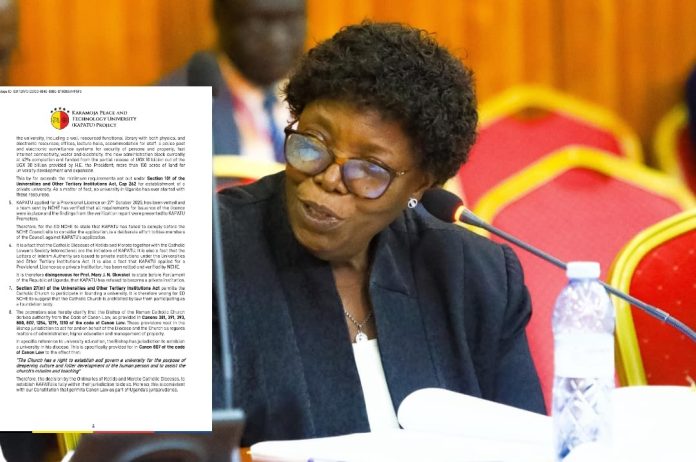


Karamoja Peace and Technology University (KAPATU) Limited has issued a response to misleading statements made by Prof. Mary J. N. Okwakol, the Executive Director of the National Council for Higher Education (NCHE). Prof. Okwakol’s comments were made during a presentation to the Sectoral Committee on Education, Parliament of Uganda, on 9th April 2026, where she claimed that the KAPATU project had stalled due to its failure to meet accreditation guidelines and governance requirements.
KAPATU strongly rejects these allegations and clarifies the situation in a detailed statement.
The promoters of KAPATU have expressed strong disapproval of what they describe as false statements, which they believe are part of a broader effort to undermine the establishment of the first university in the Karamoja Region. They further allege that the remarks are part of a wider campaign by certain actors within NCHE, the Ministry of Education, and the Attorney General’s Chambers aimed at frustrating the project’s progress.
KAPATU maintains that the project is in full compliance with Uganda’s legal requirements for university establishment, as outlined in the Universities and Other Tertiary Institutions Act. The university was granted a Letter of Interim Authority by NCHE on 19th April 2024, which set out four key requirements for progress: mobilizing funds, acquiring infrastructure, organizing academic and administrative systems, and advancing the development of the proposed university.
Contrary to the claims made by Prof. Okwakol, KAPATU says it has met and exceeded all the requirements set by NCHE. The project has secured substantial funding, including UGX 30 billion from President Museveni and EUR 300 million (approximately UGX 1.2 trillion) from international development partners. According to the promoters, these funds will not only support the university’s infrastructure but also contribute to water provision across the Karamoja region.
The physical infrastructure of the university is also said to be well underway, with a functional library, offices, lecture halls, staff accommodation, and a police post already in place. More than 150 acres of land have been secured for future expansion, while the new administration block is reportedly 42% complete, funded using part of the UGX 30 billion from the President.
The promoters of KAPATU also reject claims questioning the university’s governance structure. They state that the founding Catholic Dioceses of Kotido and Moroto have the legal authority to establish and manage the institution. They further argue that the church’s role in founding KAPATU is grounded in Canon Law, which they say grants Catholic bishops the authority to establish universities within their dioceses.
They also maintain that the appointments of President Yoweri Kaguta Museveni as Founding Chancellor and Vice President Maj. Jessica Rose Epel Alupo as Founding Deputy Chancellor were made in line with the NRA’s 10-Point Program and that there is no legal barrier to their roles.
KAPATU has called on the National Council for Higher Education and all stakeholders to act in good faith and support the realization of a university they say will bring lasting development to the Karamoja region. The promoters reaffirm that the establishment process is on track and that they remain committed to fulfilling all requirements necessary to secure a Provisional Licence for full accreditation.
They conclude that the KAPATU project is a historic initiative expected to transform the educational landscape of Karamoja while creating opportunities for the wider country.