
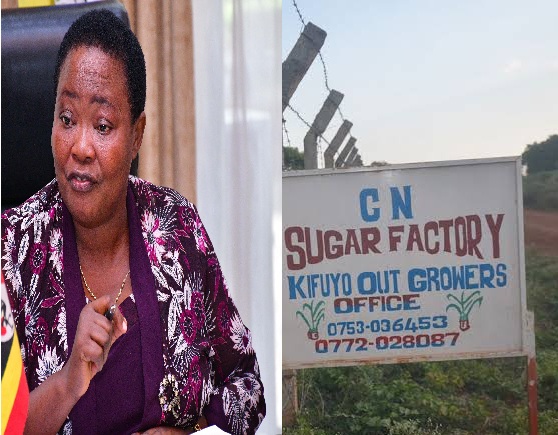


KAMPALA — Prime Minister Robinah Nabbanja and CN Sugar Limited are facing renewed scrutiny after the government announced plans to commission the company’s Namayingo factory on September 4, despite the firm’s fresh application for a sugar-mill licence still awaiting determination.
The planned commissioning has raised questions over whether the regulatory process will be allowed to take its full course, particularly after the High Court previously ordered CN Sugar to stop its milling operations until it obtained a valid licence from the legally mandated authority.
This news website has learnt that Ms Nabbanja, in a letter dated August 13, informed the Minister of Trade, Industry and Cooperatives that she would travel to Namayingo to commission the factory following a directive from President Museveni.
She also directed the minister to ensure that all necessary processes are completed before her visit.

The development has, however, put the Prime Minister’s September 4 timetable on a collision course with the licensing process, with CN Sugar’s fresh application expected to come before the Sugar Industry Stakeholders Council on August 21.
The central question is whether the factory will have secured the required licence by the time of the planned commissioning, or whether the ceremony could proceed while key regulatory questions remain unresolved.
The controversy is rooted in a High Court decision delivered on January 20, 2025, in a case brought by the Uganda Sugar Manufacturers Association against the Attorney General and other parties.
Justice Douglas Singiza Karekona found that previous permissions and purported licences issued to CN Sugar by the Ministry of Trade, Industry and Cooperatives were unlawful because the ministry did not have the statutory authority to licence sugar mills.
Under the Sugar Act, the responsibility for licensing sugar mills rests with the Uganda Sugar Board.
The court consequently cancelled the purported licences and letters of no objection issued to CN Sugar and ordered the company to halt its sugar and jaggery milling operations until it had been duly licensed by the authorised body.
The court also raised concerns over the location of the factory.
Existing sugar manufacturers had challenged the establishment of new mills in areas where sugarcane supply was already limited, arguing that factories located too close to existing mills could intensify competition for cane and undermine the viability of established producers.
The court found that CN Sugar and Shakti Sugar were located within the restricted 25-kilometre radius of existing sugar and jaggery mills and held that their establishment was contrary to the government’s sugar policy.

CN Sugar has since returned to the regulatory process with a fresh licence application.
But the timing of the Prime Minister’s planned commissioning has now become the subject of scrutiny because the application had not been determined when the September 4 date was announced.
While Ms Nabbanja’s letter does not purport to grant CN Sugar a licence, critics could question whether announcing an official commissioning date before the regulatory decision creates an expectation that the application will be approved.
The licensing authority is expected to consider whether CN Sugar has met the requirements for operating a sugar mill, including matters relating to cane supply, location and compliance with the applicable legal and regulatory framework.
If the application is approved, the company would have a legal basis to proceed, subject to any conditions attached to the licence.
However, if the application is rejected, deferred or returned for further compliance, the government would face the question of whether the September 4 commissioning can proceed.
The High Court’s previous order adds another layer to the controversy.
The court did not merely question the paperwork held by CN Sugar. It directed the company to stop its milling operations until it was licensed by an authorised institution.
A commissioning ceremony, therefore, cannot by itself substitute for the statutory approval required to operate a sugar mill.
There is also a need for clarity on the 25-kilometre radius issue identified by the court. Unless the policy has since been changed, waived through a lawful process or the circumstances surrounding CN Sugar’s location have been otherwise resolved, the issue remains relevant to the company’s fresh application.
The dispute comes at a time when government is actively promoting industrialisation and private-sector investment across the country.
A major factory in Namayingo could provide employment, create a market for farmers and contribute to local economic activity. Government officials therefore have a legitimate interest in ensuring that investments that meet the law are supported.
But investment promotion does not remove the requirement for statutory compliance.
The controversy has consequently placed both the government and the regulatory authorities in a delicate position.
For CN Sugar, obtaining the licence would remove one of the most significant legal obstacles to its operations.
For the government, ensuring that the licensing decision is made independently and transparently would help avoid perceptions that political directives are being used to influence a statutory process.
The question now is whether CN Sugar will have secured the required licence before September 4 and whether the issues raised in the 2025 High Court ruling have been fully addressed.
If the company meets the requirements, the planned commissioning could proceed with the necessary legal backing.
But if the regulatory process is still incomplete, the September 4 event could expose the government and CN Sugar to renewed questions over compliance with the law and the authority of institutions responsible for regulating Uganda’s sugar industry.
For now, the commissioning date is fixed, but the licence is not.
That gap has placed Ms Nabbanja and CN Sugar at the centre of a fresh legal and regulatory storm, with the outcome of the pending application likely to determine whether the planned September ceremony becomes a celebration of industrial investment or another chapter in the factory’s long-running legal controversy.