
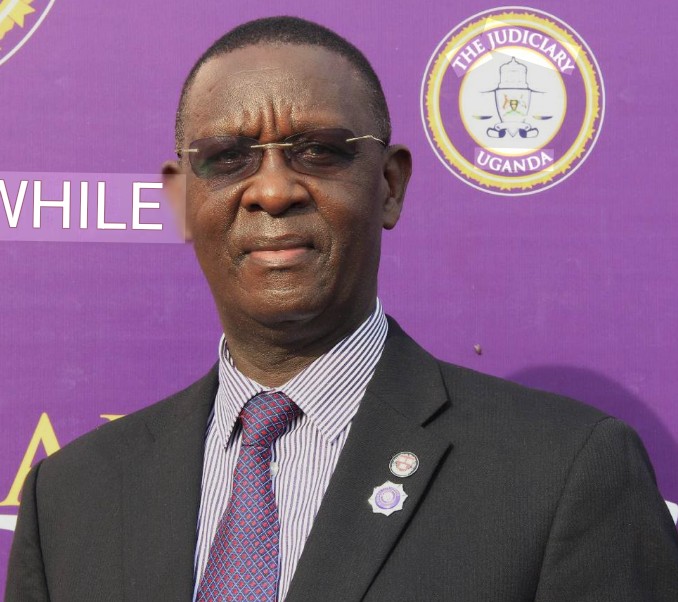


Outgoing Secretary to the Judiciary and Permanent Secretary Dr Pius Bigirimana has reflected on his long and eventful career in Uganda’s public service, declaring that he is leaving office with a distinguished record after 18 years as a Permanent Secretary while making it clear that he remains available should the country require his services again.
In an emotional reflection on his career and retirement, Bigirimana, speaking to TrumpetNews, expressed gratitude to the country’s leadership for giving him the opportunity to serve Uganda over several decades.
Bigirimana particularly hailed President Yoweri Museveni, whom he credited for identifying him, supporting him and believing in his ability, while entrusting him with several important offices during his long career in public service.
Museveni has, at several public functions, commended Bigirimana as a trusted and hardworking public officer. Years ago, when Bigirimana was transferred to the Ministry of Gender, Labour and Social Development, the ministry was widely viewed by many as dry and passive.
However, under his stewardship, the Kisoro-born technocrat helped transform the ministry into one of the more active government institutions, with programmes and initiatives targeting young people, women and other vulnerable sections of society gaining prominence.
One of the major initiatives associated with his tenure was the Youth Livelihood Programme (YLP), aimed at supporting young Ugandans to create employment and improve their livelihoods.
Bigirimana also initiated the Uganda Women Entrepreneurship Programme (UWEP), an intervention aimed at improving women’s access to financial services while equipping them with skills for enterprise growth, value addition and the marketing of their products.
The programmes became important components of the government’s broader efforts to promote financial inclusion, job creation and household income generation.
During the launch of the youth fund, Museveni famously described Bigirimana as a “pumpkin seed” — one capable of germinating even in a hostile environment — in remarks that underlined the President’s confidence in the veteran civil servant’s ability to deliver under difficult circumstances.
Now, as he prepares to leave active public service, Bigirimana says he is proud of the distinguished record he leaves behind after serving for 18 years at the level of Permanent Secretary in different government institutions.
“I go into retirement with a distinguished record,” Bigirimana said, presenting his departure from public service as the end of a long chapter defined by service, hard work and accountability.
But while he is formally stepping away from his latest office, Bigirimana made it clear that retirement does not necessarily mark the end of his contribution to the country.
He said he remains available if Uganda still needs his experience and services.
The remarks offer a glimpse into the mindset of one of Uganda’s longest-serving senior civil servants as he exits a career that has seen him serve in some of the country’s most influential government institutions.
Bigirimana served as Permanent Secretary in the Office of the Prime Minister before moving to the Ministry of Gender, Labour and Social Development. He later became Permanent Secretary and Secretary to the Judiciary, a position he held until his retirement in the latest changes affecting top government technocrats.
His tenure at the Office of the Prime Minister was also marked by a major fight against corruption. Bigirimana helped security agencies uncover a syndicated racket involving government officials accused of embezzling public funds through a network that stretched from the Office of the Prime Minister to the Ministry of Finance and the Bank of Uganda.
The investigations led to a number of officials being held accountable, with those found liable facing prosecution, conviction and dismissal from public service.
It was at the Judiciary, however, that some of the most visible chapters of his legacy were written.
During his tenure, Bigirimana played a central role in spearheading the introduction and expansion of the Electronic Court Case Management Information System (ECCMIS), a major technological intervention aimed at modernising the administration of justice.
The system was designed to improve the management and tracking of cases, reduce delays and help address the persistent problem of case backlog in the courts. The digitalisation of court processes was also seen as an important step towards increasing transparency and reducing opportunities for corruption within the justice system.
Another significant innovation during his tenure was the expansion of video conferencing facilities in court proceedings. The technology enabled judicial officers to preside over proceedings remotely while suspects or accused persons remained in prison.
This reduced the need to transport prisoners over long distances, saving time and resources while improving convenience and security. It also helped speed up proceedings and became particularly useful in linking courts with prisons across the country.
Bigirimana also presided over major infrastructure developments within the Judiciary.
Among the landmark projects during his tenure was the construction of the twin-tower building that houses the Court of Appeal and the Supreme Court. The modern facility provides high-end infrastructure for two of the country’s most important courts and forms part of the broader effort to improve the working environment for judicial officers and access to justice for Ugandans.
His tenure also saw the expansion of court infrastructure across the country. At the time of his retirement, construction of Court of Appeal facilities in Mbarara and Gulu was underway.
Meanwhile, the Soroti and Rukungiri High Court buildings were completed and commissioned, bringing judicial services closer to communities and improving the working environment for judicial officers and staff.
Beyond buildings and technology, Bigirimana also focused on the welfare of judicial officers and staff. He introduced a health insurance scheme, described as a one-of-a-kind arrangement for judicial officers across the country.
The initiative was aimed at improving access to healthcare and strengthening staff welfare within an institution that plays a central role in Uganda’s justice system.
His retirement, therefore, brings to a close nearly two decades at the level of Permanent Secretary and a much longer journey through Uganda’s public service.
However, Bigirimana’s interests are not limited to government administration. He has continued to share his knowledge and ideas with the public through his personal website and has authored a number of books.
He is also pursuing a PhD, with his research focusing on what he describes as an “abundance mentality”, a concept that centres on mindset change and the potential of individuals and societies to move away from limiting ways of thinking.
For Bigirimana, retirement may mark the end of his formal tenure as a Permanent Secretary, but it does not appear to signal a complete withdrawal from national life.
His message leaves the door open for another chapter should the country call upon him again.
“I am also available if the country still needs me,” Bigirimana said, delivering what could be his final major reflection as a serving Permanent Secretary.
It is a message from a veteran technocrat who says he is leaving office with a distinguished record, but remains ready to answer another call to national service.