
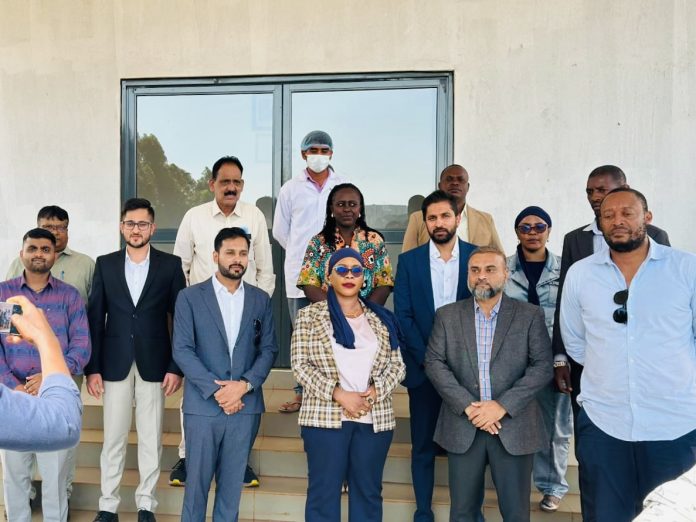


State Minister for Privatisation and Investment, Ms Amina Mukalazi, has commended Modern Laminates Limited for investing in sustainable manufacturing and embracing locally available raw materials to strengthen Uganda’s industrial capacity.
She made the remarks during a monitoring visit to Modern Laminates Limited at MMP Industrial Park in Buikwe District, where she inspected the company’s production facilities and assessed its contribution to employment, import substitution and export development.
The Minister said investments in modern manufacturing were critical to Uganda’s efforts to create jobs, promote local value addition, expand exports and reduce dependence on imported products.
Ms Mukalazi said she was particularly impressed by the company’s use of bamboo in its production processes, describing it as an example of how Uganda could turn locally available resources into high-value industrial products.
“At MMP Industrial Park in Buikwe, I engaged Mr Dhruv Thummar of Modern Laminates Limited, alongside park directors Mr Akash Dobaria and Mr Jay Patel. I commend their innovation relying on bamboo plants, which are genetically developed here in Uganda, demonstrating the potential for sustainable local value addition,” she said.
She said the development was a demonstration of the potential within Uganda’s agricultural and manufacturing sectors to work together in creating new industrial value chains.
Ms Mukalazi said the government was keen to see more manufacturers embrace local raw materials and modern technologies as a way of strengthening domestic production and making Ugandan products more competitive.
“When we use locally sourced inputs, we create opportunities for our people at different levels of the value chain. We also reduce the pressure created by dependence on imported raw materials and finished products,” she said.
The minister said Uganda could only achieve meaningful industrialisation if manufacturers were supported to expand production, adopt new technologies and develop products that could compete in regional and international markets. She added that Modern Laminates’ estimated $90 million investment was a significant contribution to Uganda’s industrialisation drive and demonstrated growing confidence in the country’s manufacturing sector.
“This investment of $90 million is a clear indication that Uganda’s industrialisation agenda is firmly on the right path. Investments of this magnitude increase our manufacturing capacity, create employment and open opportunities for local suppliers,” she said.
According to Mukalazi the government would continue engaging manufacturers to understand the challenges affecting their operations and identify areas where policy and other interventions could facilitate industrial growth.
She said manufacturers had an important role to play in transforming Uganda from a largely raw-material-producing economy into one that adds value to its resources before they reach the market.
The minister, who was accompanied by Buikwe District Woman Member of Parliament and Minister of State in the Office of the Vice President, Ms Diana Mutasingwa, also commended Modern Laminates for its contribution to employment.
She commended the company’s operations, which support hundreds of permanent workers alongside contractors and other players in its supply chain, demonstrated the wider economic impact of large-scale manufacturing investments.
“Manufacturing is not only about the factory and the machines. It is also about the jobs created, the suppliers supported, the transporters engaged and the businesses that grow around the investment,” she said.
Modern Laminates Limited has an installed paper production capacity of about 400 tonnes per day and manufactures paper and packaging products for the Ugandan and regional markets.
The company has also invested in new-generation machinery designed to improve production efficiency and optimise the use of resources.
Ms Mukalazi said such technological investments were important as manufacturers faced changing consumer demand, tighter environmental standards and increasing competition within the regional market.
“Our manufacturers must continue to innovate because the market is changing. We need companies that can respond to demand, comply with environmental requirements and still remain competitive,” she said.
Modern Laminates is also positioning itself as a regional supplier of bamboo pulp and a major player in tissue and packaging markets across Africa.
Ms Mukalazi said the company’s focus on bamboo-based production was particularly relevant to Uganda’s emerging circular economy, where industries are increasingly expected to make efficient use of resources and minimise waste.
She said Uganda had significant opportunities to develop a strong bio-economy by combining its natural resources with technology, research and private-sector investment.
“The future is in sustainable production and value addition. We have the resources, but we must invest in technology and innovation so that these resources create more value for our people,” she said.
She said the expansion of paper, tissue and packaging production would also help address demand from businesses across East Africa while strengthening Uganda’s position as a regional manufacturing hub.
Ms Mukalazi further urged manufacturers to continue working with government to identify bottlenecks affecting production and investment.
She said government’s role was to create an enabling environment while the private sector continued to invest, innovate and create productive employment.
She added that Uganda’s industrialisation targets could be achieved faster if local manufacturers continued to expand their production capacity, deepen value addition and pursue regional export opportunities.
Modern Laminates’ investment, she said, demonstrated that Uganda could attract large-scale manufacturing while simultaneously promoting local sourcing, employment and environmentally responsible production.