


 held on Tuesday, November 25, 2025, at the Serena Kampala Hotel and Conference Centre, Kamukama said Uganda’s long-term economic progress is inseparable from the growth of the wider region.)
By Hannington G. Mbabazi
Uganda is strengthening its position as a key driver of intra-East African Community (EAC) trade, with the country poised to play a leading role in shaping the region’s next phase of economic integration, according to Oscar Kamukama, Uganda’s Representative on the East African Business Council (EABC) Board of Directors.
Speaking on the sidelines of the 29th Annual General Meeting of the Private Sector Foundation Uganda (PSFU) held on Tuesday, November 25, 2025, at the Serena Kampala Hotel and Conference Centre, Kamukama said Uganda’s long-term economic progress is inseparable from the growth of the wider region.
“Uganda’s growth is tied to regional growth. When East Africa trades more with itself, all our economies rise — and Uganda is ready to champion that agenda,” he noted.
Uganda’s Strategic Place in Regional Connectivity
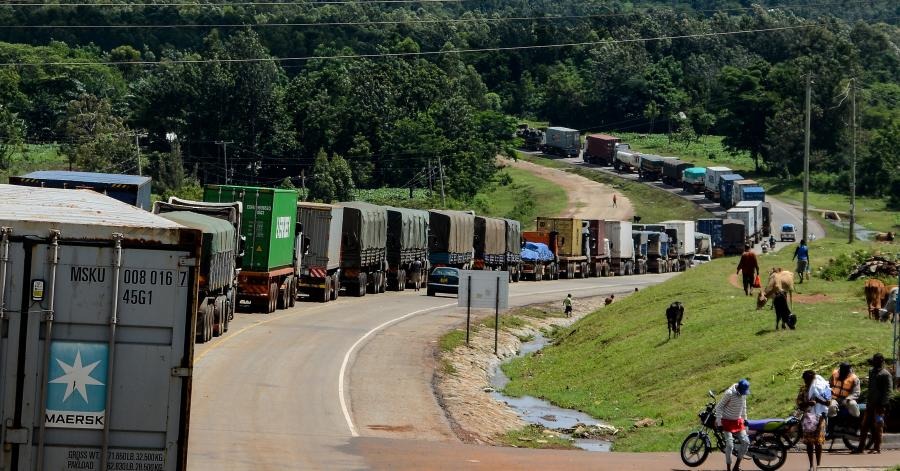
Kamukama described Uganda as a natural logistics and economic hub, positioned at the heart of key regional trade corridors linking Kenya, Tanzania, Rwanda, Burundi, South Sudan, and the Democratic Republic of Congo (DRC).
He cited ongoing national investments in transport infrastructure, digital border systems, and regional rail development as critical milestones in lowering the cost of doing business.
“Uganda is the bridge that keeps East Africa moving. We are modernizing infrastructure and digital systems to ensure goods move faster, cheaper and more reliably across the region,” he said.

Advancing the EAC Trade Agenda
Within the EABC, Uganda continues to push for reforms aimed at eliminating persistent barriers to seamless trade. Kamukama pointed to Non-Tariff Barriers (NTBs), unharmonized product standards, and unpredictable cross-border policies as key issues that must be addressed to unlock the region’s full economic potential.
“The private sector needs efficiency, not complexity. It needs harmonization, not fragmentation. Uganda is advocating for a regional business ecosystem that allows firms to scale across borders without friction,” he said.
He added that with a regional population now above 300 million, the EAC cannot afford regulatory or political constraints that slow down integration.
Uganda’s Private Sector Expanding Its Footprint
Kamukama noted that Ugandan businesses — from manufacturers and agribusiness exporters to logistics operators and service providers — are increasingly establishing a strong presence across regional markets.
“Ugandan enterprises are competitive and innovative. They are rising to the challenge, and what they need is a unified regional market. That is what we are pushing for at the EABC,” he said.

High-Value Opportunities for Ugandan Entrepreneurs
He outlined several key areas where Ugandan investors and businesses can take advantage of expanding regional demand:
Agriculture & Agro-processing: Supplying grains, dairy, poultry, fruits, vegetables and processed foods to deficit markets such as South Sudan, eastern DRC, and Rwanda.
Manufacturing: Leveraging Uganda’s growing capacity in steel, cement, pharmaceuticals, packaging, plastics, textiles and FMCGs.
Logistics & Transport: Expanding services in trucking, warehousing, cold-chain logistics, freight forwarding and e-commerce distribution.
Tourism & Hospitality: Capitalizing on the revived single-tourist visa to develop regional tour packages and hospitality investments.
ICT & Digital Services: Providing fintech, digital payments, software development, e-learning and e-commerce solutions across borders.
Construction & Real Estate: Tapping into reconstruction and infrastructure opportunities in South Sudan and DRC.
Professional Services: Benefiting from improved mobility protocols that ease movement for accountants, lawyers, architects, engineers, medical workers and consultants.
“The opportunities are not theoretical — they are real and already being seized. What we must do is scale up, formalize and fully exploit the EAC market,” Kamukama emphasized.
A Call for a More United and Competitive Region
Kamukama reiterated that the sustainability of the EAC will depend on its ability to deepen internal trade, promote value addition and build industries capable of competing beyond the region.
“The time for half-measures is over. East Africa must trade more with itself, create more within itself, and grow faster together. Uganda is not just participating — we are steering this transformation,” he said.
He reaffirmed Uganda’s commitment to working with partner states, private sector actors and regional institutions to build a more seamless, resilient and opportunity-driven EAC trading environment.