
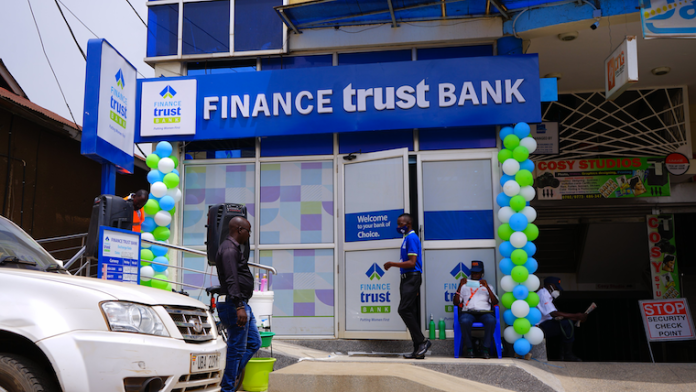


The Bank of Uganda’s decision to reclassify Finance Trust Bank (FTB) from a Tier I commercial bank to a Tier II credit institution has drawn a firm line under years of regulatory pressure, capital shortfalls, and strategic miscalculations that steadily eroded the lender’s standing in Uganda’s banking sector.
The downgrade, which takes effect on April 1, 2026, was formally communicated in a notice issued on Thursday, January 29. While FTB has described the move as a board-led strategic adjustment, industry observers say the decision merely formalised an outcome that had long appeared unavoidable.
Behind the official language lies a prolonged struggle for survival, triggered by tighter regulation, weak capital buffers, unsuccessful investor talks, and a much-publicised acquisition deal with Nigeria’s Access Bank that ultimately failed to close.
FTB’s troubles can be traced back to 2022, when amendments to the Financial Institutions Act raised the minimum paid-up capital for commercial banks from UGX 120 billion to UGX 150 billion. The central bank said the move was aimed at strengthening the banking system and shielding it from future failures.
For Uganda’s largest lenders, the new threshold posed little difficulty. For mid-sized banks such as Finance Trust, however, it presented a fundamental challenge.
According to industry sources, FTB lacked the internal capacity to bridge the capital gap on its own. The deficit, they say, was structural rather than temporary, leaving the bank dependent on external funding to retain its commercial banking licence.
Anticipating that some institutions would struggle to comply, the Bank of Uganda openly encouraged weaker players to consider mergers, acquisitions, or voluntary downgrades.
Several banks acted accordingly, including Pride Microfinance Bank, BRAC Uganda Bank Ltd, Yako Bank, Opportunity Bank, ABC Capital Bank, and Guaranty Trust Bank Uganda. The latter three exited commercial banking status within the past two years.
As regulatory deadlines approached, Finance Trust intensified efforts to stabilise its position. It entered partnerships with development-focused institutions such as aBi Trust, the East African Development Bank, and the Grow Project. These initiatives improved cash flows and supported profitability, but they fell short of satisfying regulators that the bank’s capital position had fundamentally changed.
By late 2023, insiders acknowledge that incremental measures were no longer enough. Only a significant equity injection could secure the bank’s future as a Tier I institution.
That search for capital culminated in talks with Nigeria’s Access Bank Group, one of Africa’s largest financial institutions.
In 2024, Access Bank announced plans to acquire an 80.89 percent stake in Finance Trust Bank. The proposed transaction was welcomed as a breakthrough. FTB staff, customers, and regulators viewed it as a lifeline that would inject fresh capital and strengthen the bank’s regional outlook.
FTB through Lubega Paul Percy
publicly confirmed the signing of a definitive agreement, subject to regulatory approvals from both Uganda and Nigeria. Senior executives from both institutions spoke optimistically about financial inclusion, women-focused banking, digital transformation, and regional trade expansion.
Managing Director Annet Nakawunde Mulindwa described the deal as transformative, while Access Bank’s leadership framed it as a key step in East African expansion.
On the strength of those assurances, the Bank of Uganda granted FTB additional time to remain operational beyond the capital compliance deadline, expecting the transaction to close in early 2025.
While negotiations with Finance Trust dragged on, Access Bank quietly pursued other opportunities in the region. On May 30, 2025, it completed the acquisition of Kenya’s National Bank of Kenya from KCB Group PLC a process that had begun around the same time as the FTB talks.
Unlike the Ugandan transaction, the Kenyan deal received all approvals, closed fully, and immediately expanded Access Bank’s East African footprint.
For analysts, the contrast was stark. Whether Access Bank deliberately sidelined Finance Trust or simply prioritised a larger and cleaner acquisition remains debated.
What is clear, however, is that FTB waited too long for a rescue that never arrived.
By the time it became evident that the deal would not materialise, regulatory patience had worn thin.
With no new investor, no alternative buyer, and limited room for further extensions, Finance Trust Bank was left with little choice but to downgrade.
Under the new classification, FTB will operate as a Tier II credit institution following a three-month transition period starting January 1, 2026.
The licence allows the bank to accept time and call deposits and extend credit, but it bars cheque account operations and foreign exchange trading.
The minimum capital requirement for Tier II institutions stands at UGX 25 billion far below the commercial banking threshold, but also a clear acknowledgment that FTB’s Tier I ambitions have been put on hold.
Founded in 1984 as Uganda Women’s Finance Trust, the institution was originally established to serve women and low-income communities. It later transitioned into a Tier III microfinance institution before obtaining a commercial banking licence in 2013.
However, analysts argue that the leap to commercial banking was not matched by a clearly defined strategy. Despite branding itself as a women-focused bank, FTB is said to have developed few differentiated products, competed directly with larger banks without sufficient scale, and relied heavily on donor-supported programmes.
By mid-2024, the bank operated 35 branches nationwide, but expansion alone failed to compensate for deeper governance and strategic weaknesses.
As one industry observer summed it up, Finance Trust Bank did not fail suddenly. Instead, it weakened gradually under capital pressure, strategic indecision, regulatory concessions, and a high-profile acquisition that never came to fruition.
Whether it can rebuild and redefine itself under its new status remains an open question. What is certain is that, for now, Finance Trust Bank’s chapter as a commercial lender has come to a close.
Our efforts to talk to Finance Trust or Bank of Uganda for their side of the story were futile by press time.